Can a Impeached Pres Run for President in 2020
With the impeachment trial underway into President Donald Trump's conduct, America has sailed into largely uncharted waters.
While there take been demands for the impeachment of many presidents, merely three previous ones – Andrew Johnson, Richard Nixon and Bill Clinton – have faced formal impeachment inquiries, and the Senate convicted none of them. None of those 3 sought reelection.
After Johnson'southward acquittal, he was denied his political party'due south presidential nomination. Nixon and Clinton were in their second terms already and could not run for reelection.
Trump, however, is already doing so.
As a scholar of American legal and political history, I take studied the precedents for dealing with this strange conundrum. A picayune-known contraction in the Constitution might allow Trump to be reelected president in 2022 fifty-fifty if he is removed from function through the impeachment procedure.
The constitutional framework
At the time the Constitution was ratified in 1788, many of its authors regarded impeachment every bit an improvement over the violent methods often used in Europe to get rid of corrupt rulers. Nonetheless, they recognized the dangers that impeachment would always present.

As if commenting on the current moment, Alexander Hamilton noted in 1788, that information technology will "agitate the passions of the whole community, and … divide it into parties more or less friendly or inimical to the accused. In many cases, information technology will connect itself with preexisting factions and will enlist all their animosities, partialities, influence, and involvement on ane side or the other."
The Founders were careful about defining and regulating this dangerous power. They gave the Business firm of Representatives "the sole Ability of Impeachment," and specified that the Senate "shall take the sole Power to effort all Impeachments," with a ii-thirds bulk required for conviction. They specifically prevented the president'south pardon power from reversing impeachments.
They also express the possible punishments that the Senate may impose to "removal from Role, and disqualification to concord and bask whatever Office of honor, Trust or Profit under the United States." Merely they only required that an impeached and bedevilled official "exist removed from office" – but did not mandate that the person also be disqualified from holding a hereafter office.
Nowhere does the Constitution define the standards for disqualification. Moreover, the Senate has declined to establish a standard.
But, as Ohio State University police force professor William Foley points out, Senate procedures require carve up votes to convict someone of an impeachable offense and to impose a disqualification penalisation.
So fifty-fifty if President Trump were convicted, there is the possibility that he could be reelected to the same role from which he had been removed.
Impeachment and disqualification
Of the 17 historic impeachment proceedings brought against judges and other officials who rank lower than president, 14 went to trial in the Senate and eight resulted in a guilty verdict.
In only three of those cases did the Senate bar – or "disqualify" – those who were bedevilled from holding office in the future.
First was West H. Humphreys, a federal district judge from Tennessee at the start of the Civil War, who refused to hold court and announced his support for the Confederacy. He was impeached and disqualified on charges of neglecting his judicial duties and waging war against the government of the United states.
In 1913, Robert Westward. Archbald, an associate guess of the United States Commerce Courtroom, was convicted of the more than prosaic offense of doing business concern with litigants earlier his courtroom, and forever barred from holding office. The Senate institute that he "willfully, unlawfully, and corruptly took advantage of his official position."
The 3rd case of removal and disqualification occurred in 2010. In that case, Congressman Adam Schiff, now one of the key players in the Trump impeachment hearings, took the lead in prosecuting Judge M. Thomas Porteous Jr. of Louisiana. Porteous was constitute guilty of receiving cash from lawyers who had dealings in his court, of fraudulent dealings with creditors and of misleading the Senate during his confirmation proceedings.
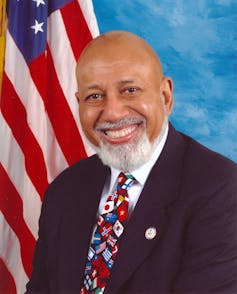
History also reveals i curious example of impeachment without disqualification, in which the person convicted ran for and won another office. Federal district estimate Alcee Hastings of Florida was removed from office in 1989 for perjury and conspiring to solicit a bribe. Since 1993, he has been representing a Florida district in the U.S. Firm of Representatives.
Other people charged with perjury and bribery, equally well every bit crimes similar taxation evasion, also have been bedevilled but non disqualified. In the end, it's hard to say what distinguishes those cases from the others.
What the Senate might make up one's mind
Professor Foley writes that if President Trump is bedevilled, the Senate should follow the Hastings precedent and not forestall him from running again for role. In Foley'southward view, the American electorate should "decide whether Trump, despite his attempt to subvert the system, should have another chance."
A Senate verdict rendered amid entrada flavour could create serious doubtfulness and deep sectionalisation about whether a president removed from function could legitimately take the adjuration of office again. Such a result might, as the president himself tweeted, "cause a Civil State of war similar fracture in this Nation from which our Country will never heal."
To avoid that severe a split, uphold the Founders' view of impeachment and minimize the perils of division that they feared, the Senate should, if the president is convicted, heed Alexander Hamilton's advice and disqualify him too, ensuring that impeachment and removal from office results in "a perpetual ostracism from the esteem and conviction and honors and emoluments of … (this) land."
Editor's annotation: This is an updated version of an article originally published October. 1, 2019, and subsequently updated November. twenty, 2019.
[ Expertise in your inbox. Sign upwards for The Chat's newsletter and get a digest of academic takes on today's news, every day. ]
lopeztheannigully.blogspot.com
Source: https://theconversation.com/could-president-trump-be-impeached-and-convicted-but-also-reelected-124384
0 Response to "Can a Impeached Pres Run for President in 2020"
Post a Comment