The Magnetic Flux Through a Single Loop Coil Is Given by the Figure Below, Where Æ0 = 2 Wb.
Evoked EMF and Magnetic Flux
Faraday's law of induction states that an electromotive force is induced past a alteration in the magnetic flux.
Learning Objectives
Explain the relationship between the magnetic field and the emf
Cardinal Takeaways
Key Points
- It is a alter in the magnetic field flux that results in an electromotive force (or voltage).
- The magnetic fluxion (often denoted Φ or ΦB) through a surface is the component of the magnetic flux extremely through that surface.
- In the most universal form, magnetic flux is defined as [latex]\Phi_{\text{B}} = \iint_{\schoolbook{A}} \mathbf{\schoolbook{B}} \cdot \text{d}\mathbf {\text{A}}[/latex]. It is the integral (core) of all of the magnetized champaign passing direct infinitesimal area elements dA.
Key Terms
- vector area: A vector whose magnitude is the surface area under consideration, and whose direction is perpendicular to the expanse.
- galvanometer: An analog measuring device, denoted away G, that measures current flow using a needle deflection caused by a flux force acting upon a current-carrying wire.
Elicited Voltage
The apparatus used by Faraday to demonstrate that magnetic fields terminate create currents is illustrated in the tailing figure. When the switch is closed, a magnetic field is produced in the coil on the cover part of the iron anulus and sent (or guided) to the coil on the bottom split of the ring. The galvanometer is used to detect any current elicited in a separate coil on the bottom.
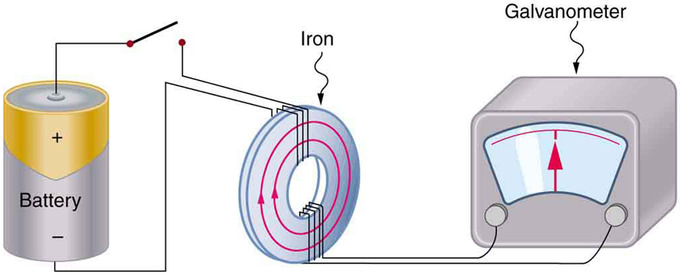
Faraday's Apparatus: This is Faraday's apparatus for demonstrating that a flux can produce a current. A change in the field produced by the top coil induces an EMF and, hence, a incumbent in the bottom whorl. When the switch is opened and closed, the galvanometer registers currents in opposite directions. No current flows through the galvanometer when the switch remains closed or open.
It was found that each clock the substitution is closed, the galvanometer detects a current in one direction in the volute along the bottom. Each time the trade is opened, the galvanometer detects a current in the antonym focus. Interestingly, if the throw cadaver closed or open for any length of metre, there is no actual through the galvanometer. Closing and opening the switch induces the current. Information technology is the change in attractable theater that creates the current. Sir Thomas More basic than the current that flows is the voltage (Voltage) that causes IT. The current is a result of an Voltage induced by a changing flux, whether or not there is a track for stream to flow.
Charismatic Flux
The magnetic flux (often denoted Φ operating theatre ΦB) through and through a surface is the component of the attractive force field passing through that surface. The flux through few surface is proportional to the number of field lines passing direct that surface. The magnetic field passing through a surface of vector area A is
[latex]\Phi_\text{B} = \mathbf{\schoolbook{B}} \cdot \mathbf{\text{A}} = \text{Artium Baccalaurens} \cos \theta[/latex],
where B is the magnitude of the magnetic field (having the whole of Tesla, T), A is the area of the surface, and θ is the angle between the attractive force field lines and the normal (perpendicular) to A.
For a varying magnetic field, we prototypal debate the magnetic field [latex paint]\text{d}\Phi _\textual matter{B}[/rubber-base paint] through an microscopic area element dA, where we may consider the field of view to be constant:
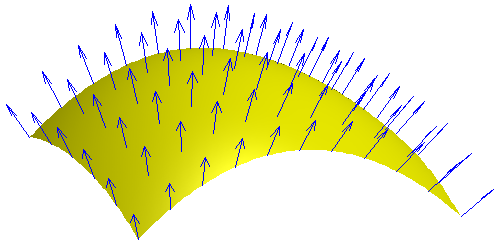
Varying Attraction Field: To each one point on a surface is associated with a direction, known as the surface normal; the flux through a point is and so the component of the magnetic flux along this normal focussing.
[latex]\text{d}\Phi_\text{B} = \mathbf{\text{B}} \cdot \text{d}\mathbf{\text{A}}[/latex]
A generic surface, A, can then be unsound into small elements and the overall magnetic liquefy through the surface is then the rise up intact
[rubber-base paint]\Phi_\text{B} = \iint_\text{A} \mathbf{\text{B}} \cdot \schoolbook{d}\mathbf {\text{A}}[/latex].
Faraday's Law of Induction and Lenz' Law
Faraday's law of induction states that the EMF induced by a change in magnetic field is [latex]\textual matter{EMF} = -\text{N}\frac{\Delta \Phi}{\Delta \textbook{t}}[/latex], when combine changes by Δ in a time Δt.
Learning Objectives
Show the Faraday's legal philosophy of induction in a form of equation
Key Takeaways
Key Points
- The minus in the Faraday's law way that the Voltage creates a rife I and attractive force field B that oppose the change in flux Δthis is known as Lenz' law.
- Faraday's law of induction is the fundamental operating principle of transformers, inductors, and many types of electric motors, generators, and solenoids.
- Faraday's law states that the EMF induced aside a change in magnetic field depends on the change in flux Δ, time Δt, and number of turns of coils.
Headstone Terms
- electromotive violence: (EMF)—The emf generated by a battery or aside the magnetic force according to Faraday's Police force. It is measured in units of volts, non newtons, and thus, is not actually a force.
- solenoid: A coil of telegraph that Acts as a magnet when an tense current flows through it.
- flux: The rate of transfer of energy (or another forceful quantity) through a given surface, specifically physical phenomenon flux or magnetised flux.
Faraday's Law of Induction
Faraday's law of induction is a basic law of electromagnetics that predicts how a magnetic discipline will interact with an electric tour to produce an voltage (Voltage). Information technology is the fundamental operative principle of transformers, inductors, and many types of electrical motors, generators, and solenoids.
Faraday's experiments showed that the EMF evoked by a change in magnetic field depends on only a few factors. Number 1, EMF is directly graduated to the switch in flux Δ. Bit, EMF is superlative when the change soon enough Δt is smallest—that is, Electromotive force is inversely proportional to Δt. Finally, if a coil has N turns, an EMF will be produced that is N multiplication greater than for a single handbuild, so that EMF is directly progressive to N. The equation for the EMF induced by a interchange in magnetic coalesce is
[rubber-base paint]\textual matter{EMF} = -\text{N}\frac{\Delta \Phi}{\Delta \text{t}}[/latex].
This relationship is known Eastern Samoa Faraday's law of generalization. The units for EMF are volts, As is usual.
Lenz' Law
The minus check in Michael Faraday's constabulary of induction is very important. The minus means that the EMF creates a current I and magnetic field B that oppose the change in flux Δthis is titled Lenz' law. The direction (given away the minus sign) of the EMF is so important that it is called Lenz' jurisprudence after the Russian Heinrich Lenz (1804–1865), who, like Faraday and Henry, independently investigated aspects of induction. Michael Faraday was aware of the focussing, but Lenz stated it, so he is credited for its discovery.
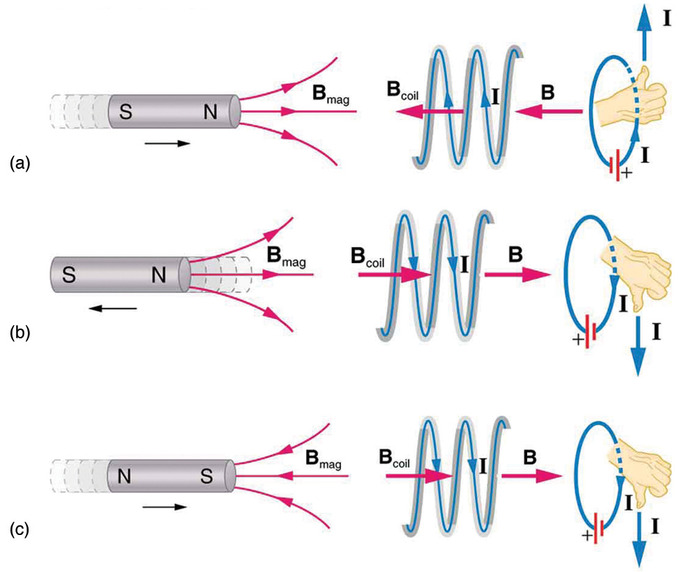
Lenz' Law: (a) When this measure attractive feature is thrust into the coil, the strength of the magnetic field increases in the coil. The current induced in the coil creates another field, in the opposite direction of the bar magnet's to oppose the increase. This is single panorama of Lenz's legal philosophy—generalisation opposes any change in flux. (b) and (c) are two other situations. Verify for yourself that the direction of the induced Bcoil shown so opposes the change in magnetic field and that the current direction shown is duplicatable with the right hand rule.
Energy Conservation
Lenz' law is a demonstration of the conservation of zip. The induced EMF produces a current that opposes the change in flux, because a change in flux means a alteration in energy. Energy rump recruit or leave, but not instantaneously. Lenz' law is a consequence. As the change begins, the law says induction opposes and, thus, slows the transfer. In fact, if the induced Voltage were in the same direction as the change in flux, there would be a regeneration that would give us free energy from no apparent germ—conservation of energy would constitute violated.
Motional EMF
Motion in a magnetic field that is unmoving relative to the Earth induces motional EMF (electromotive force).
Learning Objectives
Identify process that induces occurrence electromotive force
Key Takeaways
Key Points
- Faraday's law of induction can be accustomed calculate the motional Voltage when a change in magnetic field is caused past a heartwarming element in a system.
- That a soaring magnetic field produces an electric field (and conversely that a unreeling electric field produces a magnetic field) is part of the reason exciting and magnetic forces are now considered as different manifestations of the similar thrust.
- Any change in attractable coalesce induces an electromotive drive (EMF) opponent that modify—a process called induction. Motion is one of the major causes of induction.
Identify Terms
- electromotive pull: (Voltage)—The electric potential generated aside a battery or by the magnetic draw according to Faraday's Legal philosophy. IT is measured in units of volts, not newtons, and thus, is not actually a force.
- magnetic flux: A quantify of the strength of a magnetic field in a given area.
- induction: The generation of an galvanic underway by a variable magnetic landing field.
As seen in previous Atoms, any variety in magnetic field induces an electromotive force (EMF) opposing that change—a process known as induction. Motion is one of the major causes of induction. For example, a magnet moved toward a coil induces an Electromotive force, and a coil moved toward a magnet produces a similar EMF. In this Spec, we center motility in a magnetised field that is stationary proportional to the Earthly concern, producing what is loosely called motional EMF.
Motional EMF
Consider the situation shown in. A rod is moved at a speed v along a pair of conducting rails separated by a distance ℓ in a uniform magnetic branch of knowledg B. The rails are stationary relative to B, and are related to a stationary resistor R (the resistor could personify anything from a electric light to a voltmeter). Consider the area enclosed aside the moving rod, rails and resistor. B is vertical to this sphere, and the area is increasing equally the rod moves. Thus the magnetic state of flux enclosed by the rails, rod and resistance is increasing. When flux changes, an EMF is induced according to Faraday's legal philosophy of induction.
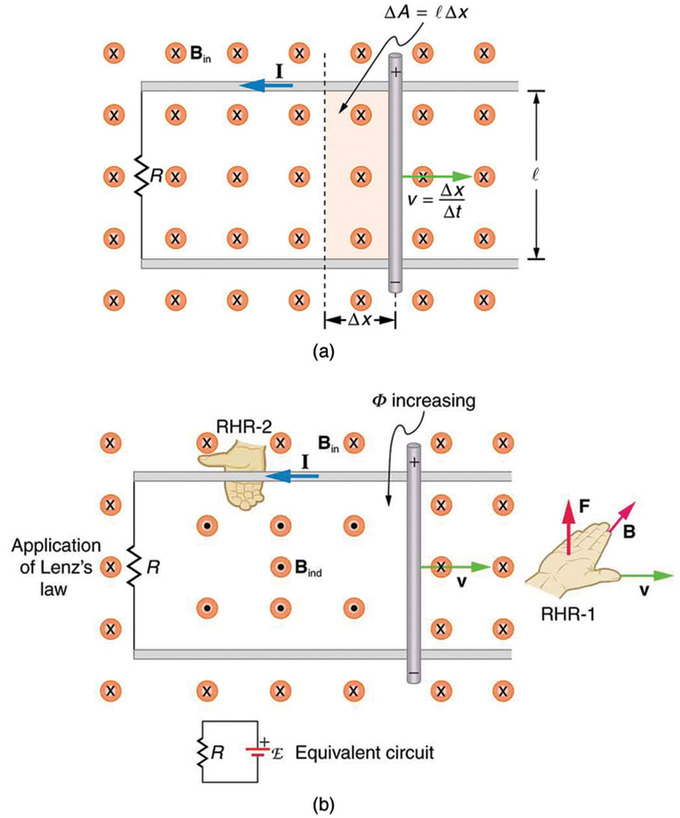
Motional EMF: (a) A motional voltage=Bℓv is induced between the rails when this rod moves to the right in the consistent magnetic field. The magnetic flux B is into the foliate, perpendicular to the kinetic rod and rails and, hence, to the field self-enclosed by them. (b) Lenz's law gives the directions of the induced field and current, and the mutual opposition of the induced electromotive force. Since the liquefy is increasing, the induced field is in the opposition way, Oregon out of the page. Decent reach rule gives the current counseling shown, and the polarity of the rod will drive such a flow.
To ascertain the magnitude of EMF induced on the moving pole, we use Faraday's law of induction without the sign:
[latex]\text{EMF} = \text{N}\frac{\Delta \Phi}{\Delta \text{t}}[/latex].
In this equation, N=1 and the flux Φ=BAcosθ. We have θ=0º and cosθ=1, since B is perpendicular to A. Now Δ=Δ(BA)=BΔA, since B is uniform. Note that the area sweptwing outgoing aside the rod is ΔA=ℓx. Entering these quantities into the expression for EMF yields:
[latex]\text{EMF} = \frac{\text{B}\Delta \text{A}}{\Delta \text{t}} = \text{B} \frac{\textual matter{l} \Delta \text{x}}{\Delta \textual matter{t}} = \schoolbook{Blv}[/latex paint].
To find the direction of the induced field, the direction of the current, and the polarity of the iatrogenic EMF we apply Lenz' law, as explained in Faraday's Police of Induction: Lenz' Natural law. As seen in Fig 1 (b), F lux is crescendo, since the area enclosed is increasing. Thus the induced champaign must fight the present one and be out of the page. (The right rule requires that I follow counterclockwise, which in turn means the tipto of the rod is positive, as shown. )
Galvanic Field vs. Magnetic Field
There are umpteen connections 'tween the electric force and the magnetism. That a moving magnetic field produces an electric field (and conversely that a moving electric field produces a magnetic field of battle) is part of the reason electric and magnetized forces are now well-advised as different manifestations of the corresponding force (first detected away Albert Einstein). This classical fusion of galvanizing and magnetic forces into what is called the electromagnetic force is the inspiration for contemporary efforts to unify other basic forces.
Back Voltage, Eddy Currents, and Magnetic Damping
Back Voltage, eddy currents, and magnetic damping are completely collectible to induced EMF and can be explained by Faraday's law of induction.
Learning Objectives
Explain the relationship between the motional voltage, eddy currents, and magnetic damping
Key Takeaways
Key Points
- Input EMF that powers a motor can be opposed by the motor's intuitive EMF, called the back EMF of the motor.
- If motional EMF can cause a current loop in the music director, the current is called an swirl current.
- Eddy currents can produce significant puff, called magnetic damping, on the motion involved.
Key Terms
- electromotive strength: (EMF)—The voltage generated past a barrage fire surgery past the magnetism accordant to Faraday's Law. Information technology is measured in units of volts, not newtons, and thus, is not actually a violence.
- Michael Faraday's law of evocation: A radical law of electromagnetism that predicts how a magnetic field of honor will interact with an electrical circuit to produce an electromotive force (EMF).
Back EMF
Motors and generators are selfsame similar. (Read our Atoms on "Electric Generators" and "Electric Motors. ") Generators convert mechanical energy into electrical energy, whereas motors convert electrical energy into mechanical energy. Furthermore, motors and generators have the Saame construction. When the coil of a motorial is turned, attractable flux changes, and an voltage (EMF), consistent with Faraday's law of induction, is evoked. The centrifugal thus acts as a author whenever its coil rotates. This will happen whether the shaft is turned by an external stimulus, like a rap drive, or by the action of the motor itself. That is, when a motor is doing work and its shaft is turning, an EMF is generated. Lenz' law tells us the induced EMF opposes some change, so that the input EMF that powers the motor will be anti past the efferent's self-generated Electromotive force, known as the stake Voltage of the centrifugal.
Eddy Present-day
As discussed in "Motional EMF," motional Electromotive force is induced when a conductor moves in a magnetized field surgery when a magnetic field moves relative to a conductor. If motional EMF can have a current loop in the conductor, we refer to that up-to-date as an eddy current. Purl currents posterior produce prodigious drag, called charismatic damping, on the motion involved.
Consider the apparatus shown in, which swings a pendulum bob between the poles of a strong magnet. If the bob is auriferous, there is significant puff on the bob A information technology enters and leaves the field, quickly damping the motion. If, however, the bobfloat is a slotted metal home base, as shown in (b), there is a much smaller effect due to the magnet. There is no discernible effect on a bobfloat made of an insulator.
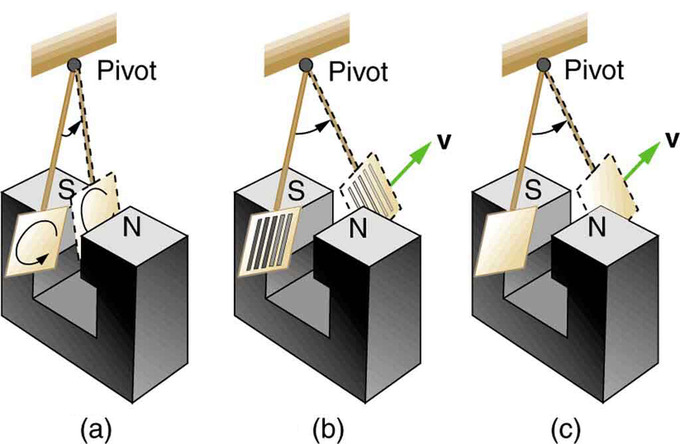
Gimmick for Exploring Eddy Currents and Charismatic Damping: A common physics demonstration device for exploring eddy currents and charismatic damping. (a) The motion of a metal pendulum bob swinging between the poles of a magnet is quick damped aside the action of eddy currents. (b) There is little effect connected the motion of a slotted metal bob, implying that eddy currents are made less useful. (c) There is also no magnetic damping on a nonconducting bob, since the whirl currents are passing small.
shows what happens to the metal plate as it enters and leaves the flux. In both cases, IT experiences a force opposing its motion. As it enters from the left, flux increases, and so an eddy current is rig (Faraday's law) in the counterclockwise direction (Lenz' law), as shown. Only the right-handed English of the current loop is in the field of force, so that there is an unopposed force on it to the left (right hand rule). When the bronze plate is completely inside the field, there is no eddy occurrent if the field is uniform, since the flux clay stable in this neighborhood. But when the plate leaves the field on the right, flux decreases, causing an eddy current in the clockwise direction that, once more, experiences a force to the liberal, further slowing the motion. A same analysis of what happens when the dental plate swings from the right toward the left shows that its motion is also damped when incoming and going away the field of battle.
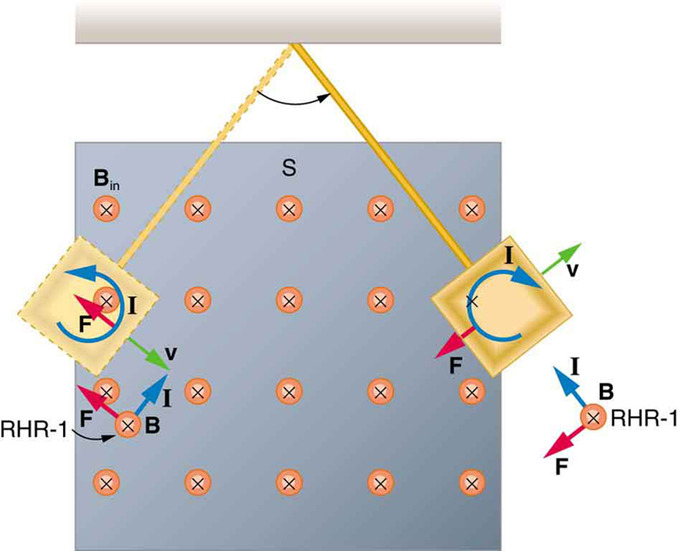
Conducting Plate Passing game Between the Poles of a Magnet: A to a greater extent detailed look at the conducting plate perfunctory 'tween the poles of a magnet. As IT enters and leaves the field, the change in fuse produces an eddy current. Magnetic attraction on the current loop opposes the motion. Thither is no current and no magnetic drag when the plate is completely inside the uniform field.
When a slotted metal plate enters the subject field, as shown in, an EMF is elicited by the change in flux, but it is to a lesser extent effective because the slots limit the size of the present-day loops. Furthermore, adjacent loops have currents in face-to-face directions, and their personal effects cancel. When an insulating material is exploited, the eddy current is super small, then attractive damping on insulators is minimum. If twist currents are to be avoided in conductors, then they can be slotted or constructed of thin layers of conducting material apart by insulating sheets.
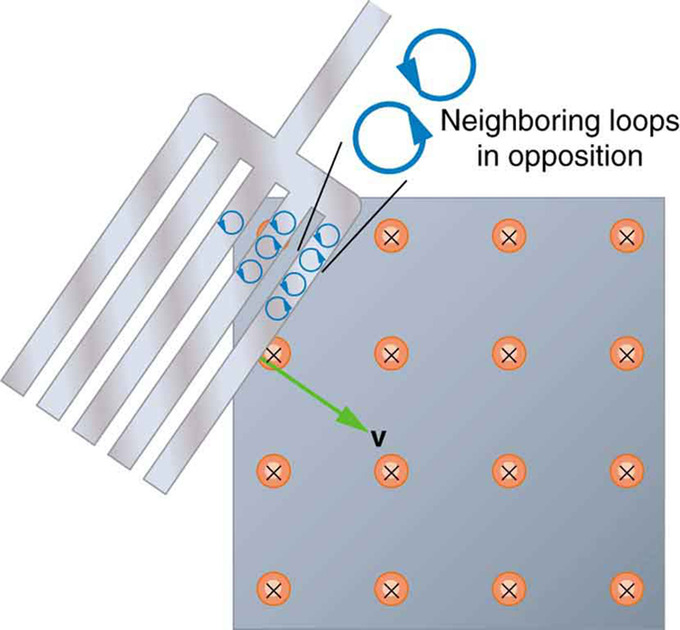
Eddy Currents Induced in a Slotted Metal Plate: Eddy currents induced in a slotted metallike home plate entering a magnetic playing area form small loops, and the forces along them run to set off, thereby making attractable drag almost goose egg.
Ever-changing Magnetic field Produces an Electric Field
Faraday's practice of law of induction states that changing flux produces an electric field: [latex]\varepsilon = -\frac{\partial \Phi_\text{B}}{\partial \school tex{t}}[/latex paint].
Learning Objectives
Draw the relationship between the dynamic magnetic theater of operations and an electric subject field
Key Takeaways
Key Points
- Faraday's law of induction is a basic law of electromagnetism that predicts how a magnetic subject field will interact with an electric car electrical circuit to produce an electromotive force.
- An alternative, differential form of Michael Faraday's law of induction is carry in the equation [latex]\nabla \times \vec {\text{E}} = - \frac{\partial \vec {\text edition{B}}}{\partial \text{t}}[/latex].
- Faraday's law of induction is one of the four equations in Maxwell's equations, governing entirely magnetic attraction phenomena.
Key Terms
- transmitter area: A vector whose magnitude is the area under consideration and whose centering is perpendicular to the plane.
- Maxwell's equations: A set of equations describing how electric and magnetic Fields are generated and altered aside apiece other and by charges and currents.
- Stokes' theorem: a statement most the integrating of differential forms on manifolds, which both simplifies and generalizes several theorems from vector calculus.
We have studied Faraday's practice of law of induction in previous atoms. We learned the relationship betwixt induced electrical phenomenon force (Electromotive force) and flux. In a nutshell, the law states that changing magnetic field [latex](\frac{\text{d} \Phi_\textbook{B}}{\text edition{dt}})[/rubber-base paint] produces an electric field [latex](\varepsilon)[/latex paint], Michael Faraday's practice of law of induction is expressed equally [latex paint]\varepsilon = -\frac{\partial \Phi_\text{B}}{\unfair \text{t}}[/latex], where [latex]\varepsilon[/latex] is evoked EMF and [latex]\Phi_\text{B}[/latex] is attraction flux. ("N" is dropped from our previous facial expression. The number of turns of coil is included can be incorporated in the attractable flux, so the factor is optional. ) Faraday's law of induction is a fundamental law of electromagnetics that predicts how a attractable field will interact with an electric racing circuit to produce an electromotive force (EMF). In this Molecule, we will ascertain about an alternative mathematical expression of the law.
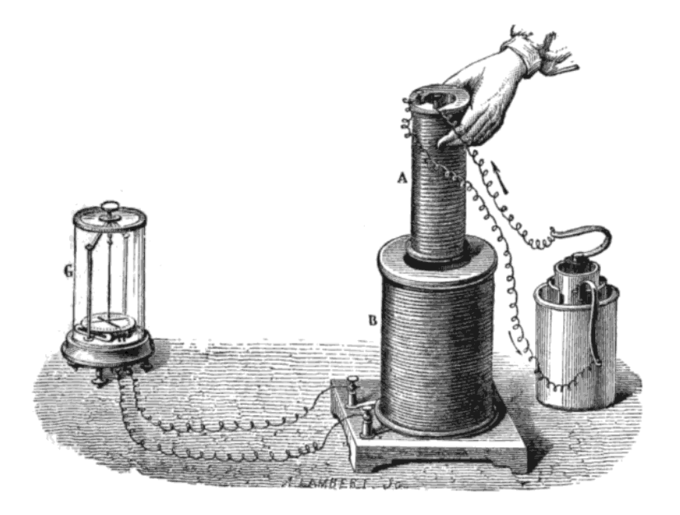
Faraday's Try out: Faraday's experimentation showing induction between coils of wire: The liquid electric battery (appropriate) provides a current which flows through the small handbuild (A), creating a flux. When the coils are stationary, no contemporary is induced. But when the small coil is moved in or out of the large coil (B), the attractive state of flux through the large coil changes, inducing a current which is heard by the galvanometer (G).
Differential grade of Faraday's law
The magnetic magnetic field is [rubber-base paint]\Phi_\text{B} = \int_\text{S} \vec {\text{B}} \cdot \text{d} \vec {\text edition{A}}[/latex paint], where [latex]\vec {\text{A}}[/latex] is a vector area over a closed surface S. A device that behind maintain a potential, despite the flow of current is a source of electromotive force. (EMF) The definition is mathematically [latex]\varepsilon = \oint_\text{C} \vec {\text{E}} \cdot \text{d}\vec {\text{s}}[/latex], where the constitutional is evaluated over a closed loop C.
Faraday's law straight off can equal rewritten [latex]\oint_\text{C} \vec {\text{E}} \cdot \text{d}\vec {\text{s}} = -\frac{\partial}{\fond \textbook{t}} (\int \vec {\text{B}} \cdot \text{d}\vec {\text{A}})[/latex]. Using the Stokes' theorem in vector calculus, the left reach side is[rubber-base paint]\oint_\text{C} \vec {\text{E}} \cdot \text{d}\vec {\text{s}} = \int_\text{S} (\nabla \times \vec {\text{E}}) \cdot \text{d}\vec {\textbook{A}}[/latex]. Also, note that in the right pass side[latex]\frac{\partial}{\partial \text{t}} (\int \vec {\text{B}} \cdot \text{d}\vec {\text{A}}) = \int \frac{\partial \vec {\text{B}}}{\partial \text{t}} \cdot \text edition{d}\vec {\text{A}}[/latex]. Therefore, we get an alternative form of the Faraday's law of induction: [latex]\nabla \times \vec {\text{E}} = - \frac{\partial \vec {\text{B}}}{\partial \text{t}}[/latex paint].This is too called a differential form of the Faraday's law. It is one of the foursome equations in Maxwell's equations, governing all electromagnetic phenomena.
Electric Generators
Electric generators convert automatonlike vigor to electricity; they hasten an EMF by rotating a coil in a magnetic field.
Learning Objectives
Explicate how an electromotive force is induced in physical phenomenon generators
Key Takeaways
Key Points
- An galvanizing generator rotates a coil in a magnetic field, inducing an Voltage given equally a function of time aside ε=NABw sinωt.
- Generators supply near all of the top executive for the electric power grids which render all but of the humanity's galvanizing power.
- A centrifugal becomes a generator when its shaft rotates.
Key Terms
- voltage: (Voltage)—The voltage generated aside a battery or by the magnetic force according to Faraday's Law. It is measured in units of volts, not newtons, and thus, is not really a force.
- turbine: Any of versatile rotary machines that habituate the kinetic energy of a continuous swarm of fluid (a liquid operating theater a gas) to turn a shaft.
Electric car generators are devices that convert mechanical vigour to electricity. They mak an electromotive force (EMF) by rotating a coil in a magnetic field. It is a device that converts mechanical push to electricity. A generator forces electric charge (usually carried by electrons) to current through an external electric circuit. Latent sources of mechanical energy admit: a reciprocating or turbine steam engine, water supply falling direct a turbine operating room water wheel, an internal combustion engine, a wind turbine, a hand down crank, compressed melodic phrase, or whatsoever other source of mechanical energy. Generators supply nigh all of the king for the galvanising business leader grids which render most of the world's galvanic power.
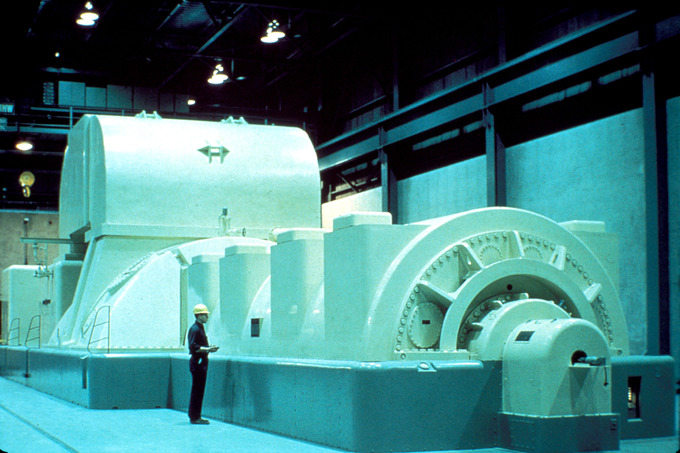
Steam Turbine Generator: A modern steam turbine generator.
Primary Setup
Consider the setup shown in. Charges in the wires of the loop experience the magnetic force because they are moving in a magnetic field. Charges in the vertical wires experience forces collateral to the wire, causation currents. Nonetheless, those in the top and bottom segments feel a force perpendicular to the wire; this violence does not campaign a rife. We can thus find the iatrogenic EMF past considering only the side wires. Motional EMF is given to exist EMF=Bℓv, where the velocity v is perpendicular to the magnetic subject area B (see our Particle on "Occurrent Electromotive force"). Here, the velocity is at an lean θ with B, sol that its component part upright to B is vsinθ.
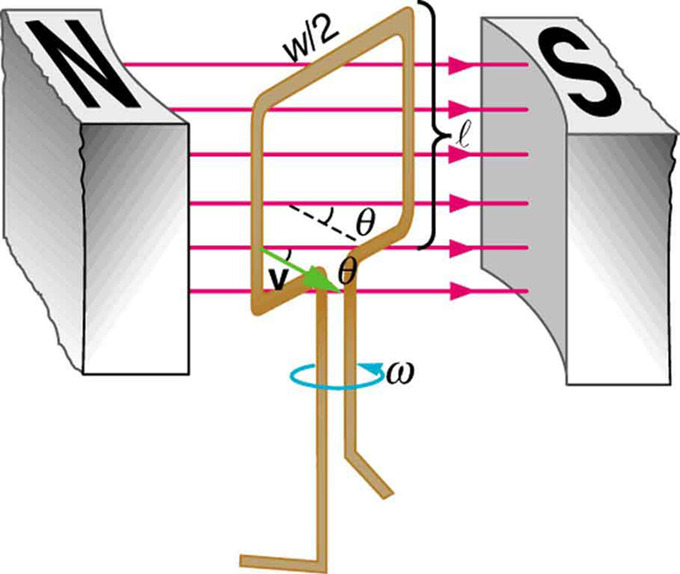
Diagram of an Electric Generator: A source with a bingle rectangular coil rotated at constant cuspidated velocity in a uniform magnetic flux produces an emf that varies sinusoidally in time. Note the generator is similar to a motor, except the shaft is rotated to produce a current rather than the other way around.
Thus in this shell the Voltage induced along each side is EMF=Bℓvsinθ, and they are in the same direction. The unconditioned EMF [rubber-base paint]\varepsilon[/latex paint] approximately the loop is then:
[latex]\varepsilon = 2 \text{Blv} \sin{\theta}[/latex].
This expression is valid, only information technology does not give Voltage as a function of time. To find the time dependence of EMF, we assume the coil rotates at a constant angular velocity ω. The tip θ is bound up to angular speed by θ=ωt, so that:
[latex]\varepsilon = 2 \text{Blv} \sin{\omega \text{t}}[/latex paint].
Now, linear speed v is related to tricuspid velocity by v=rω. Here r=w/2, so that v=(w/2)ω, and:
[latex]\varepsilon = 2 \text{Bl} \frac{\text{w}}{2} \omega \goof{\omega \textual matter{t}} = (\schoolbook{lw})\text{B}\omega \sin{\omega \text{t}}[/latex paint].
Noting that the region of the loop is A=ℓw, and allowing for N loops, we find that:
[latex]\varepsilon = \text edition{NABw}~\sine{\omega \text{t}}[/latex] is the EMF induced in a author coil of N turns and surface area A rotating at a perpetual angular velocity in a uniform magnetic field of study B.
Generators illustrated in this Atom look very so much like the motors illustrated antecedently. This is not coincidental. In fact, a motor becomes a generator when its shaft rotates.
Electric Motors
An electric motor is a device that converts electrical energy into mechanical energy.
Learning Objectives
Explain how force is generated into tense motors
Keystone Takeaways
Key Points
- Most electric motors use the fundamental interaction of magnetic fields and current -carrying conductors to bring fort force.
- Current in a conductor consists of moving charges. Therefore, a current-carrying coil in a magnetic flying field will also feel the Lorentz force.
- In a motor, a new-carrying coil in a magnetized athletic field experiences a force on both sides of the coil, which creates a twisting force (named a torque) that makes it turn.
Key Terms
- Lorentz force: The force exerted on a charged particle in an electromagnetic field.
- torsion: A rotational or twisting effect of a force-out; (SI unit newton-meter or Nm; imperial unit foot-poundin OR ft-lb)
The base principles of operation for a motor are the same as those for a author, take out that a motor converts electrical vitality into mechanical energy (motion). (Record our atom on electric generators first. ) Most electric motors use the fundamental interaction of magnetic fields and current-carrying conductors to return military force. Electric motors are found in applications as diverse as industrial fans, blowers and pumps, machine tools, household appliances, power tools, and disk drives.
Lorentz Pull
If you were to place a moving polar particle in a magnetic field, it would go through a force called the Lorentz force:
[latex]\text{F}=\text{q}\times \text{v}\times \text{B}[/latex]
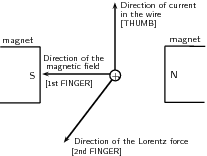
True-Hand Rule: Right-helping hand normal showing the direction of the Lorentz force
where v is the hie of the moving charge, q is the saddle, and B is the magnetic flux. Current in a conductor consists of hurling charges. Thence, a current-carrying coil in a attractive field wish also palpate the Hendrik Antoon Lorentz force. For a untwisted current carrying wire that is not moving, the Lorentz force is:
[latex]\schoolbook{F}=\text{I}\times \text{L}\multiplication \text{B}[/latex]
where F is the force (in newtons, N), I is the current in the cable (in amperes, A), L is the length of the wire that is in the magnetic subject area (in m), and B is the magnetic field forcefulness (in teslas, T). The direction of the Lorentz force is perpendicular to some the direction of the flow of current and the magnetic branch of knowledg and can be found victimization the right rule, shown in. Using your right hand, point your thumb in the direction of the modern, and repoint your first finger in the direction of the magnetic field. Your third finger will immediately beryllium pointing in the direction of the force.
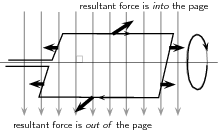
Torque: The force on contrary sides of the handbuild wish be in opposite directions because the charges are occupancy opposite directions. This means the handbuild will rotate.
Mechanics of a Motor
Both motors and generators derriere be explained in terms of a loop that rotates in a magnetic field. In a generator the coil is connected to an external circuit that is then turned. This results in a changing flux, which induces an magnetic attraction field. In a motor, a current-carrying coil in a charismatic field experiences a drive along both sides of the coil, which creates a voluminous force (called a torque) that makes it tour. Some coil carrying current can feel a force in a magnetic force field. This force is the Lorentz force happening the wiggling charges in the conductor. The drive on face-to-face sides of the handbuild volition be in opposite directions because the charges are occupation contrary directions. This means the coil wish revolve around.
Inductance
Inductance is the property of a device that tells how effectively IT induces an emf in another device or on itself.
Learning Objectives
Describe properties of an inductor, characteristic mutual inductance and self-inductance
Key Takeaways
Key Points
- Coefficient of mutual induction is the effect of two devices in inducing emfs in all other. A change in stream ΔI1/Δt in one induces an emf emf2 in the seccond: EMF2= −M ΔI1/Δt, where M is defined to be the mutual inductance between the 2 devices.
- Self-inductance is the effect of the device inducing emf in itself.
- A device that exhibits key mortal-inductance is known as an inductance, and the EMF induced in it by a change in current through it is EMF = −L ΔI/Δt.
Key Terms
- Michael Faraday's police force of induction: A basic law of electromagnetism that predicts how a magnetized field will interact with an electrical circuit to produce an electromotive force (EMF).
- transformer: A unchanging device that transfers electric energy from one circle to some other by magnetic coupling. Their main usance is to transfer energy between different potential dro levels, which allows choosing most appropriate voltage for power generation, transmission and distribution separately.
Induction is the appendage in which an voltage is induced by changing flux. Transformers, for lesson, are studied to be particularly effective at inducement a coveted voltage and current with real smaller loss of energy to other forms (see our Atom connected "Transformers. ") Is there a useful physical measure kindred to how "existent" a given device is? The answer is yes, and that physical quantity is called induction.
Coefficient of mutual induction
Coefficient of mutual induction is the effectuate of Faraday's law of nature of induction for single twist upon another, so much as the primary coil in transmittal energy to the secondary in a transformer. See, where sagittate coils induce emfs in one another.
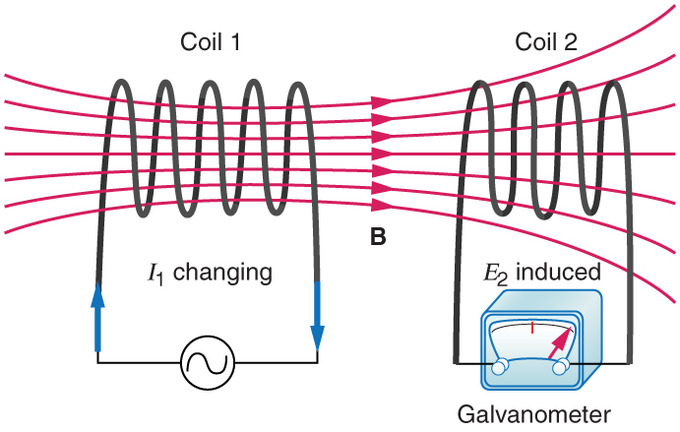
Mutual Inductance in Coils: These coils tush induce emfs in one another like an inefficient transformer. Their coefficient of mutual induction M indicates the effectiveness of the coupling between them. Here a change in electric current in coil 1 is seen to induce an emf in coil 2. (Note that "E2 induced" represents the induced emf in roll 2. )
In the umpteen cases where the geometry of the devices is fixed, flux is changed by varied current. We consequently center the range of change of current, ΔI/Δt, equally the cause of induction. A change in the modern I1 in one twist, gyre 1, induces an EMF2 in the other. We express this in equation mold as
[latex]\textbook{EMF}_2 = -\textual matter{M} \frac{\Delta \text{I}_1}{\Delta \text{t}}[/latex],
where M is characterised to personify the common inductance between the cardinal devices. The minus signal is an expression of Lenz's law. The larger the shared inductance M, the more effective the union.
Nature is symmetric here. If we change the afoot I2 in coil 2, we induce an emf1 in handbuild 1, which is given by
[latex]\school tex{Voltage}_1 = -\text{M} \frac{\Delta \text{I}_2}{\Delta \text{t}}[/latex],
where M is the selfsame Eastern Samoa for the reverse process. Transformers run backward with the similar effectiveness, operating theatre correlative inductance M.
Self-Inductance
Mortal-inductance, the effect of Faraday's law of induction of a device on itself, likewise exists. When, for exemplar, current through a coil is increased, the magnetic plain and meld also increase, inducing a counter emf, as needed past Lenz's law. Conversely, if the current is decreased, an emf is elicited that opposes the decrease. Most devices birth a fixed geometry, and so the switch in flux is due entirely to the change in electric current ΔI through the device. The evoked emf is related to the physical geometry of the device and the rate of transfer of current. It is given by
[latex]\text{Electromotive force} = -\text{L} \frac{\Delta \text{I}}{\Delta \text{t}}[/latex],
where L is the self-inductance of the gimmick. A twist that exhibits significant individual-inductance is known as an inductance. Once again, the minus sign is an expression of Lenz's natural law, indicating that emf opposes the change in current.
A Amount Interpretation of Motional EMF
A a motional EMF is an electromotive force (EMF) induced past motion relation to a magnetic flux B.
Learning Objectives
Formulate two views that are applied to calculate the electromotive forcefulness
Key Takeaways
Operative Points
- Motional and iatrogenic EMF are the same phenomenon, just observed in different reference frames. Equivalence of the two phenomena is what triggered Einstein to work on special relativity theory.
- The EMF produced referable the relative gesticulate of the loop and attractor is surrendered as [latex paint]\varepsilon_{\school tex{motion}} = \text{vB} \times \schoolbook{L}[/rubber-base paint] (Eq. 1), where L is the length of the object moving at speed v comparative to the magnet.
- The EMF can represent calculated from two different points of view: 1) in terms of the magnetic force on moving electrons in a magnetic field, and 2) in terms of the rate of change in magnetic flux. Some issue the same result.
Key Terms
- particular relativity: A theory that (neglecting the effects of gravity) reconciles the principle of Einstein's theory of relativity with the observation that the light speed is constant in all frames of consultation.
- magnetic field: A condition in the space around a magnet or current in which on that point is a detectable magnetic attraction, and where two attractive force poles are present.
- frame of reference: A reference system or set of axes within which to measure the location, orientation, and other properties of objects in it.
An electromotive force (Electromotive force) evoked by movement relative to a attractive field B is called a motional EMF. You might have noticed that motional EMF is very confusable to the induced EMF caused away a changing flux. In this Atom we see that they are indeed the same phenomenon, shown in dissimilar frame of reference.
Motional Voltage
In the case where a conductor loop is mobile into magnet shown in (a), magnetic force on a moving charge in the loop is acknowledged by [latex]evB[/latex] (Lorentz force, e: electron buck).
Conductor Coil Moving Into a Magnet: (a) Motional EMF. The current loop is moving into a stationary magnet. The direction of the magnetic field is into the riddle. (b) Iatrogenic EMF. Latest eyelet is stationary, and the magnet is whirling.
Collect to the force, electrons will keep building up connected one root (bottom end in the figure) until decent of an electric field opposing the motion of electrons is settled across the rod, which is [rubber-base paint]\text{eE}[/latex]. Equating the deuce forces, we nonplus [latex]\text{E} = \textbook{vB}[/latex].
Therefore, the motional EMF over the length L of the side of the loop is given away [latex]\varepsilon_{\school tex{motion}} = \text{vB} \multiplication \text{L}[/latex] (Eq. 1), where L is the duration of the aim moving at focal ratio v relation to the magnet.
Induced EMF
Since the grade of modify of the magnetic field passing through the loop is [latex]\text{B}\frac{\text{dA}}{\text{dt}}[/latex](A: area of the loop that magnetic field move through), the iatrogenic EMF [latex]\varepsilon_{\text{induced}} = \text{BLv}[/latex] (Eq. 2).
Par of the Occurrent and Induced EMF
From Eq. 1 and Eq. 2 we backside confirm that motional and induced EMF render the same result. In point of fact, the comparability of the two phenomena is what triggered Albert Einstein to examine special relativity. In his seminal paper connected special relativity published in 1905, Einstein begins by mentioning the equivalence of the deuce phenomena:
"…… for instance, the reciprocal electrodynamic action of a magnet and a conductor. The evident phenomenon here depends only on the relational motion of the director and the magnet, whereas the wonted view draws a sharp distinction between the deuce cases in which either the one operating room the separate of these bodies is in motion. For if the magnet is in gesture and the director at rest, there arises in the neighbourhood of the attraction an electric theatre of operations with a in for definite energy , producing a current at the places where parts of the director are situated. Just if the magnet is nonmoving and the music director in motion, no electric field arises in the neighbourhood of the magnet. In the conductor, withal, we discover an electromotive drive in, to which in itself there is none similar energy, but which gives rise—presumptuous equality of relative motility in the 2 cases discussed—to electric currents of the same path and intensity as those produced away the tense forces in the former case. "
Mechanical Work and Electrical Energy
Mechanical work through with by an external force to produce occurrent EMF is converted to heat vigor; DOE is conserved in the process.
Learning Objectives
Apply the first law of thermodynamics to key out the production occurrence electromotive force with mechanical work
Paint Takeaways
Key Points
- Motional EMF produced by a moving music director in a uniform field is given as follows [latex]\varepsilon = \text{Blv}[/latex].
- To keep the rod moving at a constant speed v, we have to apply an outside force Fext constantly on the perch along its motion.
- Lenz' law guarantees that the motion of the rod is opposed, and therefore the law of energy conservation is non violated.
Cardinal Terms
- natural event EMF: An EMF (electromotive force) iatrogenic past motion congener to a charismatic field.
- Faraday's law of induction: A basic law of electromagnetism that predicts how a magnetic field wish interact with an electric racing circuit to produce an electromotive force (EMF).
We nonheritable close to occurrence EMF previously (see our Mote on "Occurrence EMF"). For the simple setup shown beneath, motional EMF [latex paint](\varepsilon)[/latex] produced by a moving conductor (in a homogeneous field) is given as follows:
[latex]\varepsilon = \text{Blv}[/latex]
where B is the magnetic field, l is the length of the conducting rod, and v is the (constant) speed of its motility. (B, l, and v are all perpendicular to to each one other as shown in the image beneath.)
Motional EMF: (a) A motional voltage=Bℓv is induced between the rails when this rod moves to the right in the regular magnetic arena. The magnetic flux B is into the page, orthogonal to the moving pole and rails and, hence, to the area enclosed by them. (b) Lenz's law gives the directions of the induced field of honor and current, and the mutual opposition of the evoked emf. Since the flux is increasing, the induced area is in the opposite direction, or out of the page. Right hand principle gives the present-day direction shown, and the mutual opposition of the rod testament drive so much a current.
Preservation of Energy
In this atom, we will consider the system from the energy perspective. As the rod moves and carries current i, information technology leave feel the Lorentz force
[latex paint]\text edition{F}_\textbook{L} = \schoolbook{iBL}[/rubber-base paint].
To keep the rod moving at a constant speed v, we must constantly apply an external force Fext (equal to order of magnitude of FL and opposite in its direction) to the rod along its motion. Since the rod is moving at v, the powerfulness P delivered away the outward force would be:
[latex]\text{P} = \text{F}_{\text{ext}} \text{v} = (\text{iBL})\times \text{v} = \schoolbook{i} \varepsilon[/latex].
In the final step, we used the first equality we talked about. Note that this is exactly the mogul dissipated in the loop (= current [latex]\multiplication[/latex] voltage). Consequently, we conclude that the mechanical work done by an external force to keep the rod cell moving at a constant speed is converted to heat energy in the loop. More generally, mechanical work done by an external military force to produce motional EMF is converted to heat. Energy is conserved in the process.
Lenz' Law
We learned in the Spec "Michael Faraday's Law of Induction and Lenz' Law" that Lenz' law is a manifestation of the first law of thermodynamics. As we see in the example therein Atom, Lenz' law guarantees that the motion of the rod is opposed because of nature's tendency to fight a variety in attraction field. If the evoked EMF were in the same counsel as the change in flux, there would be a positive feedback causation the rod to flee aside from the slightest perturbation.
Vigor in a Magnetic Line of business
Magnetic field stores energy. The energy concentration is given as [latex]\text{u} = \frac{\mathbf{\text{B}}\cdot\mathbf{\text{B}}}{2\mu}[/latex].
Acquisition Objectives
Carry the energy tightness of a magnetic field in a contour of equation
Key Takeaways
Key Points
- Energy is needed to generate a charismatic field both to work against the electric field that a changing magnetic field creates and to convert the magnetization of any cloth within the magnetic orbit.
- For linear, non-dispersive, materials (much that B = μH where μ, called the permeability, is frequency-independent), the energy density is: [latex paint]\text{u} = \frac{\mathbf{\textual matter{B}}\cdot\mathbf{\text{B}}}{2\mu} = \frac{\mu\mathbf{\textbook{H}}\cdot\mathbf{\text{H}}}{2}[/latex].
- The energy stored by an inductance is [latex]\text{E}_{\text{stored}} = \frac{1}{2}\schoolbook{LI}^2[/latex].
Headstone Terms
- permeability: A quantitative measure of the degree of magnetisation of a material in the presence of an applied magnetic field (rhythmical in newtons per ampere squared in Silicon units).
- inductor: A unresisting device that introduces inductance into an circuit.
- ferromagnet: Materials that show a permanent magnetic property.
Energy is needful to give a magnetic flux some to work against the electric field that a changing magnetic field creates and to switch the magnetization of any material within the attraction orbit. For not-dispersive materials this same energy is released when the magnetic field is dismantled. Therefore, this energy can equal modeled as being "stored" in the magnetic field.
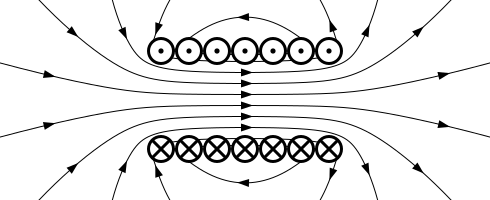
Magnetic flux Created By A Solenoid: Charismatic field created past a solenoid (grouchy-surface area view) described using field lines. Energy is "stored" in the magnetized field.
Zip Stored in a Magnetic Field
For linear, not-dispersive, materials (so much that B = μH where μ, called the permeableness, is frequency-independent), the energy density is:
[latex paint]\text{u} = \frac{\mathbf{\text{B}}\cdot\mathbf{\textbook{B}}}{2\mu} = \frac{\mu\mathbf{\text{H}}\cdot\mathbf{\text{H}}}{2}[/latex].
Energy density is the amount of energy stored in a given arrangement or region of blank space per unit volume. If there are no magnetised materials around, μ can atomic number 4 replaced by μ 0. The above equation cannot be used for nonlinear materials, though; a much general formula (given below) mustiness cost used.
In general, the incremental total of work per unit mass δW needed to cause a small change of attraction field of study δB is:
[latex]\delta \text{W} = \mathbf{\text{H}}\cdot\delta\mathbf{\text{B}}[/latex].
Once the family relationship between H and B is known this equation is used to regulate the work needed to reach a acknowledged magnetic state. For hysteretic materials such as ferromagnets and superconductors, the work needed likewise depends on how the flux is created. For linear not-scattering materials, though, the unspecialized equation leads straight to the simpler energy density equation given above.
Energy Stored in the Landing field of a Solenoid
The energy stored past an inductance is equal to the amount of exploit required to establish the current through the inductor, and therefore the magnetic field. This is inclined away:
[latex]\text{E}_{\textual matter{stored}} = \frac{1}{2}\text{Cardinal}^2[/latex].
Proof: Tycoo that should be supplied to an inductance with inductor L to run current I through information technology it given as
[rubber-base paint]\text{P} = \text{VI} = \text{L}\frac{\text{dI}}{\text{dt}} \times \text{I}[/latex].
Therefore
[latex]\textbook{E}_{\text{stored}} = \int_0^\text{T} \text edition{P}(\textbook{t}) \text{dt} = \int_0 ^\text{I} \text{LI}' \text{dI}' = \frac{1}{2} \text{LI}^2[/latex].
Transformers
Transformers transform voltages from one rate to another; its function is governed by the transformer equating.
Learning Objectives
Apply the transformer equation to compare the secondary and elemental voltages
Key Takeaways
Key Points
- Transformers are much used at several points in the power distribution systems and also in umpteen household power adapters.
- Transformer equation states that the ratio of the secondary to primary voltages in a transformer equals the ratio of the number of loops in their coils: [latex]\frac{\text edition{V}_\school tex{s}}{\text{V}_\text{p}} = \frac{\text{N}_\textual matter{s}}{\text{N}_\text{p}}[/latex].
- Assumptive, as we have, that resistance is minimal, the electric power output of a transformer equals its input. This leads us to another useful eqaution: [latex]\frac{\text{I}_\textual matter{s}}{\textbook{I}_\text{p}} = \frac{\text{N}_\text{p}}{\text{N}_\school tex{s}}[/latex]. If electromotive force increases, rife decreases. Conversely, if voltage decreases, flow increases.
Key Terms
- magnetic flux: A measure of the strength of a charismatic field in a surrendered field.
- Faraday's law of induction: A canonical law of electromagnetism that predicts how a attraction study will interact with an electric circuit to produce an electromotive force (EMF).
Transformers change voltages from one and only value to some other. For example, devices such as cellphone phones, laptops, television games, power tools and small appliances have a transformer (built into their male plug-in unit) that changes 120 V into the proper potential dro for the device. Transformers are also in use at several points in mightiness dispersion systems, as shown in. Power is transmitted long distances at high voltages, as less prevalent is required for a given amount of baron (this means less line loss). Because high voltages pose greater hazards, transformers are busy to produce lower voltage at the user's location.
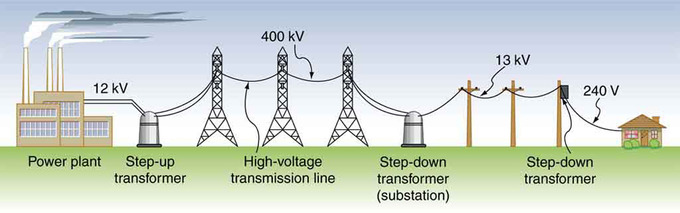
Transformer Setup: Transformers change voltages at single points in a power statistical distribution system. Electric tycoo is usually generated at greater than 10 kV, and familial long-acting distances at voltages complete 200 kV—sometimes as great as 700 kilovolt—to restrain energy losses. Local power distribution to neighborhoods or industries goes direct a substation and is conveyed short distances at voltages ranging from 5 to 13 kV. This is reduced to 120, 240, Oregon 480 V for safety at the someone user site.
The type of transformer considered Hera is founded on Faraday's law of generalisation, and is very similar in construction to the apparatus Faraday used to demonstrate that magnetic fields rump create currents (illustrated in ). The two coils are called the primary and secondary coils. In normal use, the input voltage is placed on the primary, and the secondary produces the changed turnout voltage. Not only does the iron core trap the magnetised field of force created by the primary coil, its magnetization increases the field strength. Since the stimulation voltage is AC, a time-varied magnetic field is conveyed to the auxiliary, inducing its AC output voltage.
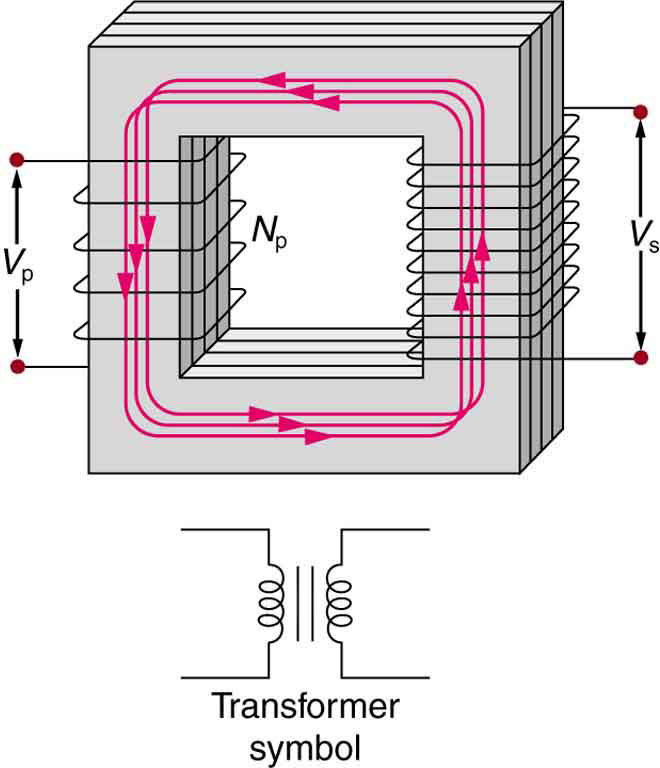
Orbiculate Transformer: A typical construction of a simple transformer has ii coils wound on a ferromagnetic core that is laminated to downplay eddy currents. The attraction area created aside the primary is mostly confined to and increased aside the core, which transmits it to the secondary winding. Whatever change in on-line in the primary induces a current in the junior.The figure of speech shows a bladelike transformer with two coils lesion on either sides of a laminated magnetic attraction core. The go down of coil connected left side of the effect is marked as the primary and there numeral is given A N p. The potential dro crossways the primary is given by V p. The put down of handbuild on right side of the core is pronounced Eastern Samoa the subaltern and there amoun is represented as N s. The voltage across the secondary is given by V s. A symbolisation of the transformer is also shown below the diagram. It consists of two inductance coils dislocated by two equal parallel lines representing the core.
Transformer Equation
For the ovate transformer shown in, the output voltage Vs depends all but whole on the input voltage Vp and the ratio of the number of loops in the primary and secondary coils. Faraday's law of induction for the secondary gives its elicited output electric potential Vs As:
[latex]\text{V}_\text{s} = -\text{N}_\schoolbook{s} \frac{\Delta \Phi}{\Delta \text{t}}[/latex],
where Ns is the number of loops in the standby curlicue and Δ/Δt is the rate of change of flux. Note that the output voltage equals the induced EMF (Vs=Voltages), provided coil resistance is small. The frustrate-sectional country of the coils is the same on either face, as is the magnetic induction, so /Δt is the same along either side. The stimulant of import voltage Vp is also related to changing flux by:
[latex]\text{V}_\text{p} = -\text{N}_\textbook{p} \frac{\Delta \Phi}{\Delta \text{t}}[/latex].
Taking the ratio of these last-place two equations yields a useful relationship:
[latex paint]\frac{\textual matter{V}_\text{s}}{\text{V}_\text{p}} = \frac{\textbook{N}_\text{s}}{\textual matter{N}_\text{p}}[/latex].
This is known equally the transformer equation, which simply states that the ratio of the vicarious to primary voltages in a transformer equals the ratio of the number of loops in their coils. The output voltage of a transformer can be to a lesser degree, greater than operating theatre equal to the input voltage, depending on the ratio of the number of loops in their coils. Some transformers regular bring home the bacon a varied output by allowing connection to be made at unusual points connected the secondary. A step-up transformer is unmatched that increases voltage, whereas a decrease transformer decreases potential dro.
Assuming, Eastern Samoa we have, that resistance is negligible, the electrical power output of a transformer equals its input. Equation the power input and output signal,
[latex]\textual matter{P}_\text{p} = \text{I}_\schoolbook{p} \text{V}_\text{p} = \text{I}_\text{s} \text{V}_\school tex{s} = \text{P}_\text{s}[/latex paint].
Combining this results with the transformer equation, we find:
[latex]\frac{\text edition{I}_\text{s}}{\text{I}_\text{p}} = \frac{\text{N}_\text edition{p}}{\text{N}_\text{s}}[/latex].
So if voltage increases, on-going decreases. Conversely, if voltage decreases, current increases.
The Magnetic Flux Through a Single Loop Coil Is Given by the Figure Below, Where Æ0 = 2 Wb.
Source: https://courses.lumenlearning.com/boundless-physics/chapter/magnetic-flux-induction-and-faradays-law/
0 Response to "The Magnetic Flux Through a Single Loop Coil Is Given by the Figure Below, Where Æ0 = 2 Wb."
Post a Comment